20 August
Cover Stories / Publications
Trust: Your Business’s Brand Asset In The Age Of Ai
- The Brand March
- 0 Comments
We are living in information abundant age, commonly referred to as ‘info-obesity’. Every day, consumers research and are exposed to overwhelming amount of information and AI-generated content. While this may feel empowering, it also leads to confusion and delayed decision making.
What has become imperative for businesses is not just to be visible, but to engage meaningfully and build relationships, closes deals, and drives sustainable growth.
The B2B Branding Landscape
Nearly 4,000 B2B decision-makers across 13 countries were surveyed in McKinsey’s 2026 Global B2B Pulse, confirming that omnichannel engagement is now a baseline expectation for B2B companies.
The liner purchasing journey is no longer applicable.
Omnichannel presence is the solution. Today’s buyers research, review and validate businesses across multiple channels throughout their purchase journey. What has become imperative for businesses is to provide a seamlessly flow of information across these channels by being consistently sharing knowledgeable insights, practical expertise, and quick solution-based content that buyers can absorb. Every meaningful interaction helps build familiarity and strengthens brand association.
Gen Z is changing how B2B buying decisions are made.
With more Gen Z professionals joining the workforce, businesses need to connect with them where they spend most of their time researching and making decisions. They find peer-led communities, online-research, Large Language Models (LLMs) and AI powered tools more reliable. Thoughtful communication through these platforms significantly influences how they perceive and engage with your brand.
How B2B businesses can cut-through the noise and connect with your audience.
Today buyer’s journey has been redefined. It is no longer about moving prospects through a traditional sales funnel. Instead, it is about connecting with your audience, engaging them with meaningful information, and being present wherever they are likely to discover and evaluate with your business.
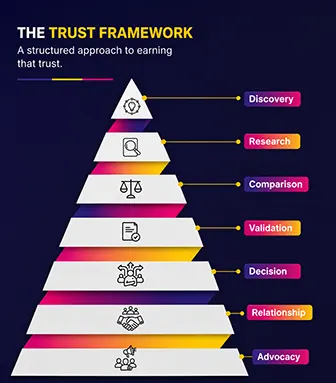 Trust Framework For Businesses
The foundation of every remarkable business lies in its capabilities, expertise and the value it delivers to customers. However, in the age of digitalisation, hyper-personalised communication, consciously crafting trust for your audience has become equally important.
Discovery
Being discovered where your audience spends most of their time is the first step towards building trust. A planned and structured discovery strategy across SEO, AI prompts, LinkedIn, your website, industry platforms, and other relevant omnichannel touchpoints helps your business stay visible and relevant.
Research
This is one of the crucial stages of the Trust Framework. Once your audience discovers your business, your responsibility is to keep them engaged through relevant educational, technical and authoritative content. This would include case studies, use cases, customer testimonials, peer review, earned coverage, customer reference, and thought leadership that reinforces your expertise.
Comparison
While engaging with your content, your audience is also evaluating your competitors. They compare your expertise, messaging and communication style, customer experience and industry capability.
At this stage, trust is built not only through remarkable products or services but also through your ability to understand customer challenges and provide relevant solutions.
Validation
Your brand now enters the evaluation and consideration stage. Your audience is seeking validation from their peer, colleagues, industry experts, and existing customers. The proof and clarity they receive during this stage often becomes the deciding factor.
Decision
Your interactions with the audience throughout the Trust Framework have built sufficient credibility and confidence for buyers choose your business as their preferred partner. The decision now is based on trust your brand has consistently established.
Relationship
Cementing relationship with your consumer through the experience of your products or services delivery, quality as promised, support and effectiveness of solutions becomes the strongest drivers of customer retention.
Advocacy
At this stage, customers are no longer simply consuming your products or services. They begin recommending your business, sharing their experiences, referring new opportunities, and becoming your strongest brand advocates. This is where trust transforms into sustainable business growth.
The Trust Framework provides a structured approach to earning that trust.
To summarise
For businesses, growth has never been built on transactions alone. It has always been built on relationships, reliability, and reputation.
AI may change how buyers discover your business, but it cannot replace the confidence that comes from consistent delivery, technical expertise, and genuine customer relationships.
In the years ahead, companies will no longer compete only on innovation, quality, or pricing. They will compete on credibility. And the businesses that invest in building trust today will become the brands their customers choose tomorrow.
Related Posts